

I’ve had some readers ask me to clarify this from my article “When Love Is a Tug of War: The Step-Parent Reality.” In the article it states: “Loyalty doesn’t always attach to the person who is safest. Sometimes it attaches to the person who is most unpredictable. Children will defend the parent whose love feels unstable — even when that parent causes guilt, emotional chaos, and fear of abandonment. And they will reject the parent who feels emotionally safe — because that relationship doesn’t feel at risk.” I want to take a moment to address this concept, because it is confusing for many people looking in from the outside. Why would a child attach themselves so fiercely to the parent who seems the least stable? Why would they defend a parent who doesn’t show up consistently while turning cold toward the parent who always shows up with love?
Here’s why: Some children grow up with a biological parent who gives attention sparingly — just enough to keep the child hoping, craving, and working for more. A parent who is often disinterested in the child’s world, yet rules the home with an authoritarian style. The message becomes: “You only get my attention when you please me… and you avoid my anger at all costs.” In that dynamic, the child quickly learns to revolve around the parent’s moods, wants, and emotional climate. They become hyper-attuned to what will keep the peace. They don’t question whether the parent’s behavior is healthy — they’re just trying to survive and maintain connection. So when that parent does give praise or affection — especially tied to behaviors that show “loyalty” — it lands like gold.
For example: If a child treats the step-parent rudely, and the bio parent responds by rewarding that behavior with attention, approval, or pride, the child feels an intoxicating moment of connection — a moment they’ve been starving for. That moment is enough to override their internal discomfort. It’s enough to make them double down on the loyalty test. It’s enough to keep them caught in the cycle. Because inconsistent love can feel more powerful than steady love — especially to a child who’s learned that safety is a guarantee, but affection is not.
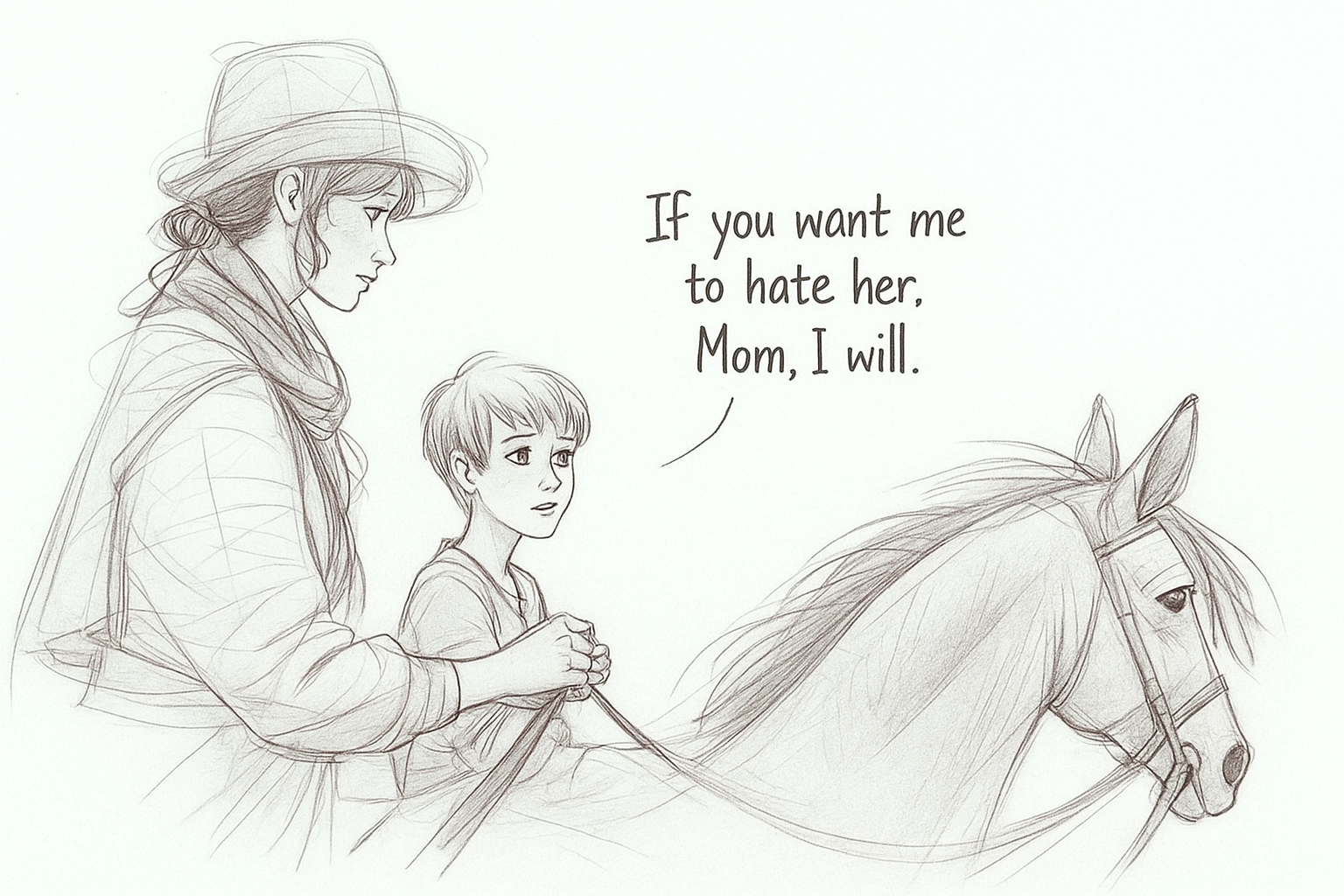
A perfect example of this dynamic appears in the movie “Stepmom.” There’s a scene during horseback riding where the young son quietly says to his mother: “If you want me to hate her, Mom, I will.” That line hits hard. The look on Susan Sarandon’s face makes the viewer realize she’s confronted with the truth that her child is bending himself to fit her emotional needs, not his own. The loyalty he’s offering is not born from genuine dislike of the stepmom — it’s born from a desire to stay close to his mother, whose approval feels fragile. It’s a painfully honest moment. And it’s in the movie because it reflects real life. Children often align themselves with the parent whose love feels the most unstable — because they’re protecting the relationship they fear losing. Meanwhile, the parent who offers steady, unconditional safety becomes the one the child feels secure enough to push away… not because they love that parent less, but because they trust that parent more.
It’s heartbreaking. It’s human. And it’s something blended families quietly struggle with every day. If you find yourself parenting in the middle of this dynamic — where loyalty, love, and emotional safety get tangled up in confusing ways — please hear this: You are not failing. You are not imagining it. And you are not alone. Blended families often operate inside emotional landscapes that were shaped long before you arrived. You may be offering the safest love a child has ever experienced… and still feel pushed away. You may be doing everything right and still feel like the outsider. You may be sowing seeds you won’t see the harvest of for years. But your steady presence matters more than you know.
Children eventually recognize the difference between conditional love and unconditional love, between someone who needs loyalty and someone who offers security, between a parent who demands allegiance and a parent who simply keeps showing up. Your reliability becomes their anchor. Your calm becomes their safety net. Your consistency becomes their roadmap out of chaos. It may not feel dramatic or celebrated in the moment… but it is transformational. Blended family love is often quiet, slow-growing, and unseen — until suddenly it isn’t. One day, children look back and realize who stood with them, who guided them, and who offered the kind of love that didn’t have to be earned.

So keep going. Keep showing up. Keep being the steady place their hearts can land. Even if they don’t fully understand it today, you are building something strong, rooted, and real — the kind of love that doesn’t demand loyalty, but naturally earns it over time. Your presence is making a difference. Your patience is planting seeds. And your love is shaping a future that is healthier, safer, and more whole than the past that came before it.
From my blended heart to yours 💛
Kari
Leave a Reply